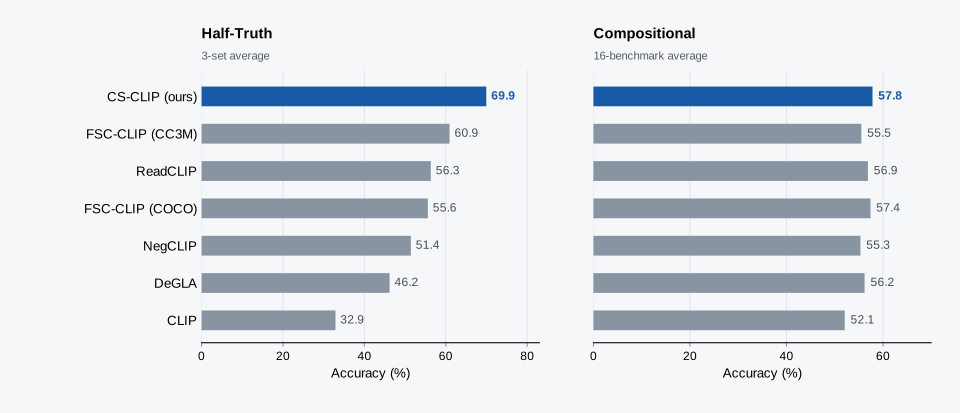
When a text description is extended with an additional detail, image-text similarity should drop if that detail is wrong. We show that CLIP-style dual encoders often violate this intuition: appending a plausible but incorrect object or relation to an otherwise correct description can increase the similarity score. We call such cases half-truths. Across 1,437 verified comparisons from COCO and CC3M using two foil generators, we find that this failure persists across generators and image domains. On COCO with Qwen-generated foils, CLIP prefers the correct shorter description only 34.0% of the time, dropping to 27.8% for relation additions. We trace this vulnerability to weak supervision on caption parts: contrastive training aligns full sentences but does not explicitly enforce that individual entities and relations are grounded.
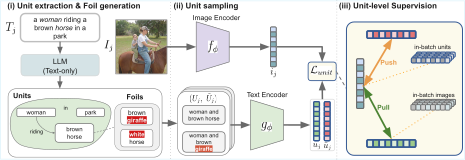
We propose CS-CLIP (Component-Supervised CLIP), which decomposes captions into entity and relation units, constructs a minimally edited foil for each unit, and fine-tunes the model to score the correct unit above its foil while preserving standard dual-encoder inference. CS-CLIP raises half-truth accuracy to 76.4% on this set and improves average performance on established compositional benchmarks by 5.8 points, suggesting that reducing half-truth errors aligns with broader gains in compositional understanding.